This beautiful male Ferruginous Duck was found by Tage Holdgaard Andersen on 12 February 2013 and it was still present today in Sminge Sø near Silkeborg where it was mainly associating with a female Pochard. It seems to prefer to leave the site whenever fishermen sail on the lake; however, it has been twitchable each day as it returns when the human activity on the lake stops. It is the 64th national record and only the 3rd in East Jutland - these three have all been adult males.
søndag den 17. februar 2013

søndag den 10. februar 2013
Fritlevende fasaner i fantastiske farveladefarver
 |
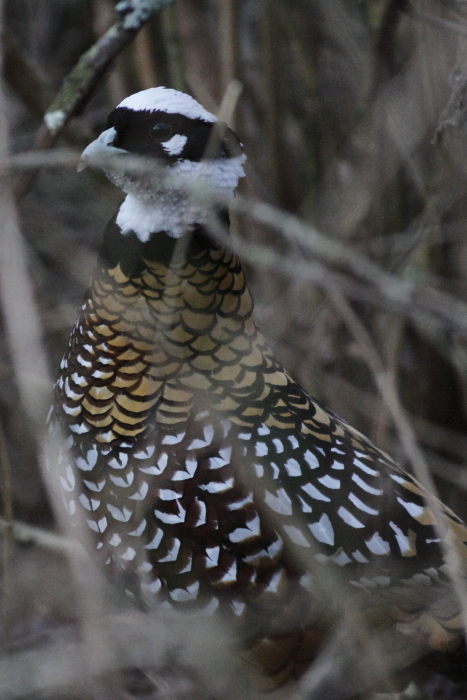
| Fasanen, som vi kender den i dag, er grundlæggende en krydsning mellem ædelfasanen (uden hvid halsring) fra Kaukasus og ringfasanen (med halsring) fra Kina. Derfor har langt de fleste fasaner her i landet en hvid halsring. Der er dog gennem tiden krydset mange andre racer og mutationer ind i den danske fasan-genpulje, så man i dag kan se et utal af variationer i fjerdragtenføj billed. |
Billederne her er alle taget indenfor en radius af 10 km omkring Feldballe, hvor jeg igennem det seneste år har haft lidt fokus på diverse fasaner. Ved Møllerup Gods nordvest for Feldballe ligger et fasaneri, hvorfra et stort antal individer sætte ud hvert efterår og 2012 har det bl.a. inkluderet en del hvide fugle, men også nogle Kongefasaner. Det er første gang jeg ser andet end de normale fasaner omkring godset, men det er dog ikke første gang jeg ser fritgående Kongefasan i lokalområdet. Sidste vinter gik jeg nogle flere ture i Skramsø Plantage for at eftersøge Spurveugle og en dag kom forbi en ejendom, hvor de havde Kongefasaner i en store voliere, men overraskende nok sås også en del hanner og hunner fritgående i læhegnene og skoven omkring gården. Hvor længe de har levet fritgående i området er usikkert, men Kongefasan må siges at være en spektakulær fugl, der på alle måde imponerer.
 |
| Den grønne fasan kendes under det latinske navn Phasianus colchicus mut. tenebrosus og der er tale om en melanistisk farvemutant, hvor dyrene mangler lyse pigmenter i fjerene. Mutationen er fremkommet flere gange uafhængigt af hinanden, hvorfor der blandt fænotypen ”grøn fasan” kan være en del variation i farvetegningerne. Den blev første gang konstateret i England i 1880 og i Danmark i 1902. |
 |
| Jeg formoder, at det er sådanne mørke fasaner, der har ført til meldinger om japanske grønne fasaner (Phasianus versicolor). Men på trods af deres overfladiske ligheder, er den identifikation er ikke korrekt. Som billederne viser, så er sådanne fugle er ikke blot sortbrune fasaner, som det kunne forventes af melanistiske fugle, men alt efter lysforhold fremstår de grønne, lilla eller blå (eller sorte). Udtrykket "melanistisk" er hyppigt anvendt til disse fugle, men det er måske ikke teknisk korrekt at beskrive denne iridiserende fjerdragt som melanistisk. Disse flotte fugle betragtes som tidligere nævnt som en variation, eller mutation, af normale fasaner. |
 |
| Hvid fasan kendes under betegnelsen Phasianus colchicus mut. isabellinus. |




mandag den 4. februar 2013
American White-winged Scoter (deglandi), 2.2.2013, Blaavandshuk, Denmark
Distant and pour quality photos I acknowledge; however, together with the more convincing photos on Netfugl taken by the original finder Troels Eske Ortvad, they document a first for Denmark. It is an American White-winged Scoter (deglandi) and please note how the head shape even in the dodgy photos differs from what was seen on the Stejneger's Scoter (Melanitta deglandi stejnegeri) seen at the same site on October 17, 2010. The head shape also matches the deglandi on the beautiful plate from: Garner, M., Lewington, I. & Rosenberg. G. 2004 Stejneger’s Scoter in the Western Palaearctic and North America. Birding World Vol.17:8 (337-347). Nice bird and a very good find.


 |
| Note that the flanks appear to be brown as in deglandi |
 |
| ... again note the brown flanks |
Amerikansk Sortand, han, 19.10.2010, Blåvand-Hvidbjerg Strand, Blåvandshuk
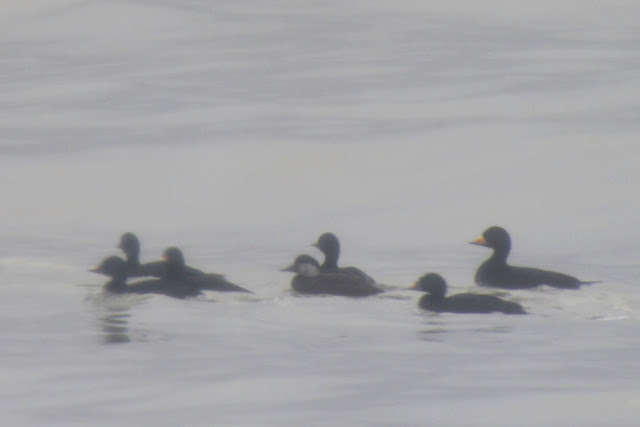
This male Black Scoter (Melanitta americana) was photographed on February 2, 2013 near Blåvandshuk on the Danish west coast. However, it has been returning each winter to the exact same spot since it was originally discovered on March 3, 2003.




 |
| Note that Black Scoter (Melanitta americana) has more bulbous head shape and thicker neck than Common Scoter (Melanitta nigra) |


 |
| Note that Black Scoter (Melanitta americana) (in center) has obvious inflated trombone cheeks in contrast to Common Scoter (Melanitta nigra) where the cheeks are less significant |


søndag den 6. januar 2013
Blue-winged Teal, 1cy male, 21 December 2012, Golf del Sur, Tenerife
During a family holiday on Tenerife I managed a few hours birding on 21 December 2012. As I only had a few hours before sunset I went straight to Golf del Sur on the south side of the island only 20 minutes drive from our hotel in Los Christianos.
The golf course itself was very quiet so I went down to the small pond to scan the assortment of wild and feral wildfowl. On the lake there was 1 Bar-headed Goose, 1 leucistic female Mandarin Duck, 10+ Muscovy Ducks and 37 Fulvous Whistling Ducks. Does anyone know if Fulvous Whistling Duck breed ferally on Tenerife?
There were also good numbers of Coot, Moorhen, Cattle & Little Egret. Genuine good wintering birds or vagrants on Tenerife included 1 male Mallard (or was it also introduced?), 3 Eurasian Teals and a nice 1cy male Blue-winged Teal.


The golf course itself was very quiet so I went down to the small pond to scan the assortment of wild and feral wildfowl. On the lake there was 1 Bar-headed Goose, 1 leucistic female Mandarin Duck, 10+ Muscovy Ducks and 37 Fulvous Whistling Ducks. Does anyone know if Fulvous Whistling Duck breed ferally on Tenerife?
There were also good numbers of Coot, Moorhen, Cattle & Little Egret. Genuine good wintering birds or vagrants on Tenerife included 1 male Mallard (or was it also introduced?), 3 Eurasian Teals and a nice 1cy male Blue-winged Teal.
 |
| Blue-winged Teal showing off its spectacular wing coverts |
 |
| Note that even though faint is aready beginning to 'ghost' the white lateral rump patch indicating toghether with the male-like upperwing the sex |

 |
| A mix of wild and feral wildfowl plus a single Moorhen walking in the background |
 |
| Does anyone know if Fulvous Whistling Duck breed ferally on Tenerife? |


 |
| Leucistic female Mandarin Duck. What is the history of this? |
mandag den 12. november 2012
More about 'Sailed' Eiders
Several people have posted photos
of Northern borealis Eiders online and as I find the
subject stimulating, I try to keep track on information and gather links for
future reference and comparison. Recently, new material have been posted
including some beautiful individuals photographed in West Greenland
by Rasmus Due Nielsen
in early April 2012, and some great photos taken by Henrik Haaning Nielsen and Søren Kristoffersen on Svalbard this
summer. I would also like to highlight the photos Peter Adriaens and Leif Jonasson have taken in
Iceland, and these from Svalbard and this
individual in Massachusetts.
.
This individual from Bønnerup Harbour in March 2006 is interesting for several reasons. It has small white scapular sails, a rather high forehead and colour full frontal lobes. However, the white feathers stop under the middle of the nostrils and not below the rear edge as in the first national claim from Hanstholm Harbour indicating that this bird could have mixed genes.

There are also nice series of more or less 'Sailed'
birds from sites south of the normal borealis range including photos from Scotland
provided by Martin Reid and Chris Gibbins
(here and here). On Birdguides and Birding the day away there are several
individuals from UK and Martin Garner and Brydon Thomason have
written about the subject as has Henrik Haaning Nielsen based on birds in museum collections.
In Denmark we have so far had five records in total
and surprisingly all have been in 2012 indicating that ‘Sailed’ Eiders could be
more regular now that we have started focusing on them then expected from the
number of claims. The first in Denmark was seen in April in Hansthol
Harbour (here and here); the
second was in Skagen in June (unfortunately there are only online photos of
this individual on Facebook: here, here, here, here and here); the
third was seen near Aarhus Harbour in the beginning
of October; and the fourth was seen in late October and November in Hanstholm
Harbour (here, here and here) -
could this be the first claim returning to the exact same site? Finally number
five was seen on Læsø in November.


Whether they all five are true borealis or whether a bit
of intebreeding could perhaps be clouding issues is difficult to determine with
certainty. However, Henrik Haaning Nielsen has evaluated the
proposed characters against individuals seen on Svalbard and online photos, and
he suggests that the extension of white feathers on side of the bill could also
be of importance. The character should be that on borealis the white
feathers often end below the rear edge of the nostrils whereas in mollissima the white often end below the middle
of the nostrils. Very exciting and certainly a character I will try to test on
Danish mollissima this winter. When I scroll through the
'Sailed' Eiders from Ythan Estuary, the
feather-to-nostril character seems to be highly variable, but that may not be
the case within their core range, but only among individuals with mixed genes.
Whether the Hanstholm Harbour birds in the pictures below are a
returning individual or a new bird is difficult to determine. However, I have the impression that it might well be the same. The small
differences could be within the individual year-to-year variation. The scapular
sails are slightly higher here in October and November compared to April, but
that is only to be expected as such exposed feathers will become worn during
winter and thus become smaller in spring.
 |
| April 2012, Hanstholm Harbour. Foto: John Kyed. |
 |
| November 2012, Hanstholm Harbour. Foto: John Kyed. |
 |
| November 2012, Hanstholm Harbour. Foto: John Kyed. |
.
This individual from Bønnerup Harbour in March 2006 is interesting for several reasons. It has small white scapular sails, a rather high forehead and colour full frontal lobes. However, the white feathers stop under the middle of the nostrils and not below the rear edge as in the first national claim from Hanstholm Harbour indicating that this bird could have mixed genes.
fredag den 9. november 2012
Tre Nordisk Lappedykkere sammen på Læsø
Lørdag den 3. november 2012 besøgte jeg Storedal på nordkysten af Læsø, da lokaliteten er kendt for at huse godt med havdykænder. Med stor fornøjelse kunne jeg her tjekke mindst 1000 Fløjsænder og et tilsvarende antal Sortænder under rigtig gode forhold både mht. afstand, lys og bølger. Pludselig poppede en klassisk Nordisk Lappedykker op i kikkertfeltet, hvor der hidtil kun havde været en del Gråstrubede Lappedykkere. Mens jeg filmede den ene fugl poppede yderligere to individer, så der kunne ses tre Nordiske Lappedykkere samtidig som det også fremgår af videoen.


torsdag den 8. november 2012
'Sailed Eider', 3.11.2012, off Vesterø, Læsø
On November 3, 2012 I found another ‘Sailed Eider’ in Denmark. This is my third individual this year alone indicating that they are more regular than the number of records suggest. Whether they are true Northern 'borealis' Eiders or they represent intergrades between borealis and mollissima is yet undetermined. However, the characteristics of the Danish individuals are replicated within true borealis populations in the north Atlantic such as West Greenland, Northern Iceland (or are they hybrid populations?) and wintering Eiders at Svalbard.
Besides the white scapular sails several other characters indicate some degree of borealis influence, such as the head which had a high and steep forehead; the feathered white area on the side of the bill which was pointed and the black feathering below the frontal bill lobes which was very narrow; the frontal lobes on the forehead which were rather pointed and brightly coloured; and finally the white tertials which were very long and even obviously hanging down over the white rump patch.
According to the literature, the key features of adult male Northern Eider in relation to European Eider are:
However, one has to acknowledge that between borealis and mollissima there is a high degree of variation and overlap in these characters; thus most characters are not to be considered diagnostic, but only indicative.

According to the literature, the key features of adult male Northern Eider in relation to European Eider are:
- Two stiffer modified long scapulars creates presence of white sails on the back
- Colour on the bill base, many have orange tones over the bill base
- Legs and feet colour match the bright yellowish orange tones of the bill base
- The feathered black stripe running down the side of the bill lobe is very narrow
- The feathered white area on the side of the bill is more pointed and lack the rounded tip
- The feathered white area on the side of the bill ends below the rear edge of the nostril
- The lobes differ in shape being more pointed
- Bill shape differ structurally tending to be more elongated and drooping towards tip
- Black cap often has a straight lower edge
- Head shape tend to be squarer with steeper forehead
- Breast can be richer, deeper salmon colour
- White tertials are were very long and obviously hanging down over the white rump patch
However, one has to acknowledge that between borealis and mollissima there is a high degree of variation and overlap in these characters; thus most characters are not to be considered diagnostic, but only indicative.
 |
| Head shape was rather squarer with steep forehead |
 |
| The feathered black stripe running down the side of the bill lobe was very narrow |

 |
| The feathered white area on the side of the bill was rather pointed and seemed to end below the rear edge of the nostril |
 |
| Note the slightly orange tones over the bill base |
2012 er allerede et historik år i Østjylland
Med hensyn til forekomsten af sjældne og fåtallige fugle i Østjylland kan 2012 vist allerede kaldes et historisk godt år. Alene blandt de fugle jeg har set skal Gråvinget Måge og Hvidvinget Måge rastende igennem længere tid ved søerne i Universitetsparken i januar fremhæves. Dernæst fra april 10 Hvidnæbbede Lommer nordvest for Anholt, en 2K han Brilleand ved Grenå, en Bjergpiber i sommerdragt ved Kolindbro Enge og en Vendehals i baghaven. Maj bød på min første Gulhovedet Gul Vipstjert i Østjylland og dagen efter så jeg sammen med Alex Sand Frich en trækkende hun Hedehøg ved Gjerrild kort efter en Pirol havde lavet trækforsøg samme sted. Maj bød også på to Hvidskæggede Terne i Brabrand Sø, mens juni overraskede med en han Blåvinget And ved Egå Engsø og en Lille Skrigeørn nord for Ebeltoft på samme dag foruden en syngende Perleugle kunne nydes i Gludsted Plantage natten efter. Efter en lidt stille sommer slog efteråret i oktober til med landets 3. fund af en 'Sailed' Eider ved Århus Østhavn, en ringmærket Steppegærdesanger (Sylvia [curruca] halimodendri) ved Totten på Anholt efterfulgt af en Amerikansk Pibeand han ved Hornbæk Enge ved Randers og senest landets andet fund af Brun Tornskade ved Årslev Engsø. Intet mindre end imponerende.
onsdag den 7. november 2012
Siberian Lesser Whitethroat (Sylvia [curruca] blythi) on Anholt in Denmark
UPDATE: The result of the genetic analysis confirms what we had always thought - that this was a Central Asian Lesser Whitethroat somewhere on the blythi—halimodendri spectrum and based on cytokrom b the bird falls into the blythi clade as defined in the recent paper by Olsson et al (2013).
*********
Jag har kollat fågeln från Anholt, och sekvensen hamnar i exakt samma klad som holotypen av blythi. Så baserat på cytokrom b är den helt klart blythi.
Bästa hälsningar
Urban
*********
I have now posted a feather of the Lesser Whitethroat from Anholt to Urban Olsson who kindly promised to analyse its DNA in order to specify geographical origin.

I am so very pleased that both Lars Svensson and Urban Olsson so kindly spend time on evaluating this Danish record and the whole Lesser Whitethroat complex in general. It’s very exciting and inspiring.
*********
Hej Kent,
Jag har kollat fågeln från Anholt, och sekvensen hamnar i exakt samma klad som holotypen av blythi. Så baserat på cytokrom b är den helt klart blythi.
Bästa hälsningar
Urban
*********
I have now posted a feather of the Lesser Whitethroat from Anholt to Urban Olsson who kindly promised to analyse its DNA in order to specify geographical origin.

I am so very pleased that both Lars Svensson and Urban Olsson so kindly spend time on evaluating this Danish record and the whole Lesser Whitethroat complex in general. It’s very exciting and inspiring.
mandag den 5. november 2012
Second record of Brown Shrike in Denmark
This 2cy+ Brown Shrike (Lanius cristatus) was found on November 4, 2012 at Årslev Engsø near Aarhus in Denmark.


 |
| The long, rufous-toned tail is strongly graduated (note in other photos the particularly short outermost tail feather), and the wing appeares relatively short (with only five-six primaries clearly visible beyond the tertials). It sported a strong grey- and pink-based, black-tipped, bill and could look rather bull-headed which, along with the well-defined facial pattern (including a bold dark mask and broad pale supercillium), the earthy brown upperparts and the strongly contrasting tertial fringes, are all supportive characters. |


 |
| Relatively large head and strong bill with deep base and strong curved culmen. |

 |
| Note the rounded tail shape due to difference between t6 and t5. Rather short primaryprojection (c. 60%). |
fredag den 2. november 2012
Amerikanske Pibeand ved Hornbæk Enge er første fund i Østjylland nogensinde
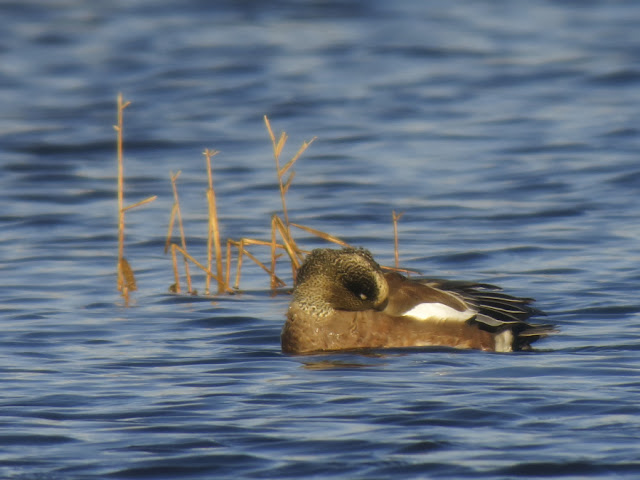
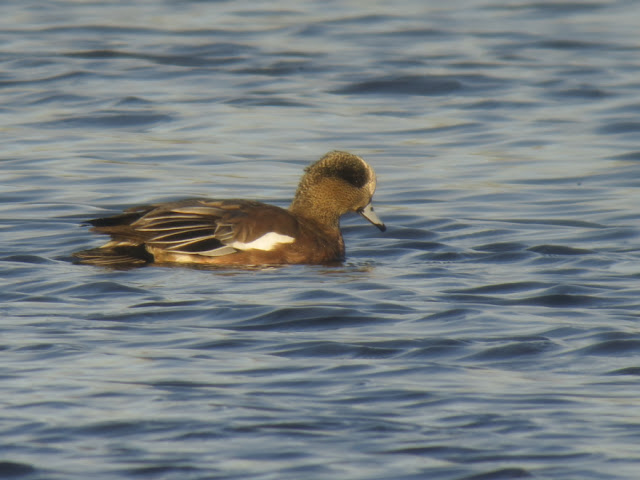
Den 30. oktober 2013 fandt Lars Tom Petersen (LTP) en Amerikansk Pibeand han ved Hornbæk Enge i sydvesthjørnet af Randers. Det er første fund af arten i Østjylland og den har således været længe ventet. Som det fremgår af billederne er fuglen på vej i pragtdragt og har kun få rester af eklipsedragten hist og her. Fuglen raster sammen med 1000 Europæiske Pibeænder, der har været i området i en måned og såfremt den bliver liggende er der god mulighed for at følge den resterende fældning til pragtdragt foruden bræmmefældningen, der gerne skulle gøre ansigtsmasken tydeligere grøn og pandeblissen mere hvidlig elfenbensfarvet og veldefineret.






 |
| Vi brugte naturligvis en del tid på at udelukke en hybrid og med forbehold for at en 2. eller 3. generations hybrid måske ikke kan udelukkes, så er fuglen helt igennem perfekt og indenfor den velbeskrevne variation hos Amerikansk Pibeand. Bemærk således den sort indramnings af næbbasis, der trods varierende bredde er meget fremtrædende, den hvidgule pandeblis, der strækker sig langt op på issen og afsluttes som en kile bag øjnene og kun forlænges som en hestehale hele vejen ned over det bagerste af isse, nakken og det bagerste af halsen i en anden mørk grålig farve. Den har således en smal distinkt nakkekam, hvilket er meget karakteristisk. Det lykkedes andre at se de hvide undervinger, men jeg har ikke selv haft mulighed for at vurdere undervinger og armhulefjer. Som pluskarakterer er fuglen marginalt større end Europæiske Pibeand og ligger lidt højere i vandet, har højere og stejlere pande, længere centrale halefjer, bredere hvidt felt på gumpsider (kun venstre side pga. manglende eklipsefældning på højre side). |


 |
| Der er ingen ringe på benene. |


Abonner på:
Opslag (Atom)